The true story
HMS Vanguard, 9 July 1917
Just before midnight on 9 July 1917, the battleship HMS Vanguard blew up at anchor in Scapa Flow, Orkney. Almost her entire crew died in an instant. It is believed to be the worst accidental loss of life in the Royal Navy's history, yet few people outside Orkney have heard of it.
This disaster is the starting point of Souls of Scapa Flow. The novel is fiction, but everything on this page is fact, checked against the Royal Navy, Orkney Islands Council and other published sources.
The ship
HMS Vanguard was a dreadnought battleship, launched at Barrow-in-Furness on 22 February 1909 and commissioned in 1910. She served with the Grand Fleet, whose main anchorage was Scapa Flow, and fought at the Battle of Jutland in 1916.
One of her ship's bells, dated 1 March 1910, is on display at the Dock Museum in Barrow-in-Furness.
The night of 9 July 1917
Vanguard was lying at anchor about a mile north of the island of Flotta. At about 11.20pm witnesses saw flame, then a series of internal explosions tore the ship apart. She sank almost at once.
A U-boat attack was suspected at first, but the loss was an accident. The Court of Inquiry found that the most likely cause was an internal explosion of faulty cordite, probably in one of her magazines. The usual explanation is that a fire next to a magazine heated the cordite until it ignited, but the exact trigger was never proven.
How many died
The figure most sources give is that 843 of the 845 men aboard were killed. Two survived: Marine J. Williams and Stoker First Class F.W. Cox. A third man, Lieutenant Commander A.C.H. Duke, was pulled from the water but died of his injuries a few days later.
Other counts exist. Research based on Commonwealth War Graves Commission records lists 835 men who died that night, partly because some of the crew were ashore or on other ships.
Lyness Royal Naval Cemetery
Few bodies were recovered. Orkney Islands Council gives the number of Vanguard's crew buried in Lyness Royal Naval Cemetery on the island of Hoy as 41, and the cemetery has a memorial cross to the ship. Most of the First World War graves at Lyness are of men from HMS Vanguard and HMS Hampshire. The rest of Vanguard's crew remain with the wreck.
The wreck today
The wreck lies in about 34 metres of water off Flotta. It was heavily salvaged for metal before it was protected. It was marked as a war grave in 1984 and is now a Controlled Site under the Protection of Military Remains Act 1986, which means no one may dive on it or disturb it without a licence from the Ministry of Defence.
In Souls of Scapa Flow, two divers break that law. In real life, the wreck is guarded by it.
The bell raised in 2025
In the summer of 2025, a volunteer dive team from the Orkney charter boat MV Huskyan recovered Vanguard's ship's bell, a badge from one of her main guns and a tampion, the plug that sealed a gun barrel. The bell had been distorted by the explosion. The work took three years of planning and was carried out with special permission from the Royal Navy.
The National Museum of the Royal Navy says the items were found outside the protected zone around the wreck and remain Ministry of Defence property. After conservation they are to be lent to the Scapa Flow Museum at Lyness, where the Royal Navy said they would form the centrepiece of a new exhibition. No opening date had been announced when this page was checked in October 2026.
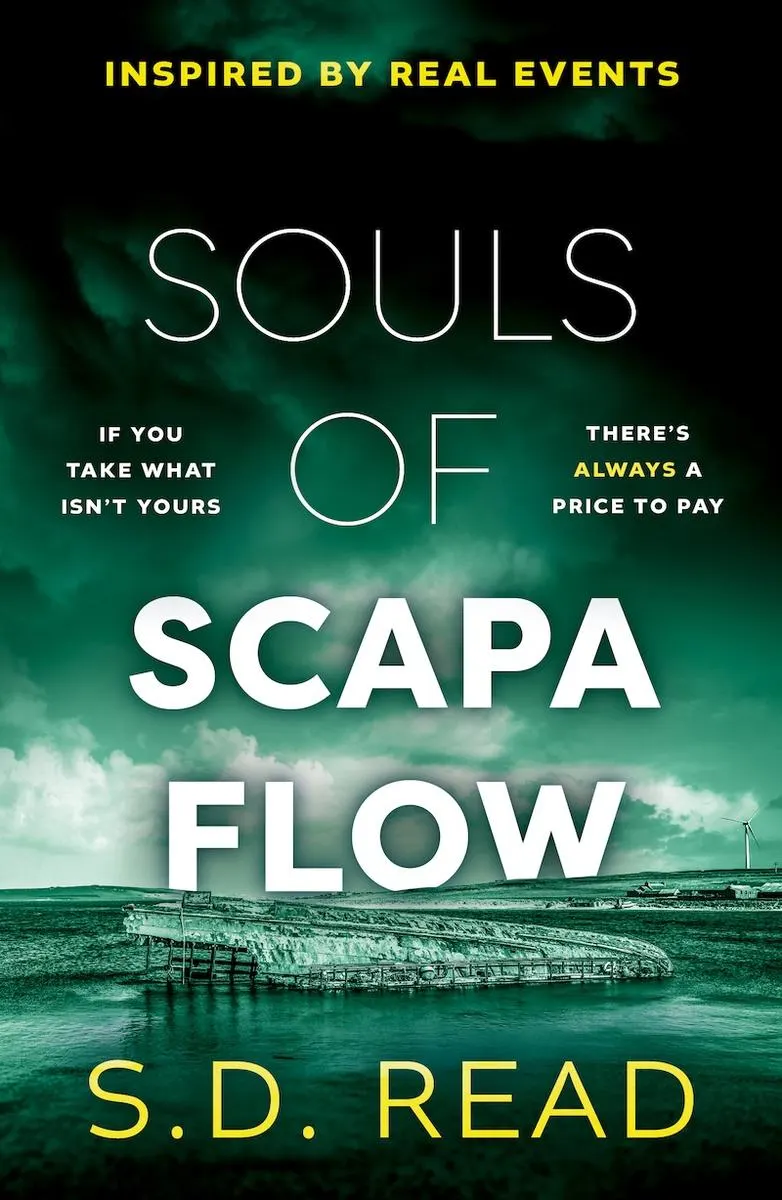
Souls of Scapa Flow was published a few months later, in November 2025: a novel about what happens when objects are taken from the wreck without permission.
How Vanguard is remembered
For the centenary in July 2017, wreaths were laid over the wreck from Royal Navy vessels, and services were held at Lyness and in St Magnus Cathedral in Kirkwall. The Scapa Flow Museum at Lyness tells the story of the ship alongside the other naval losses in Scapa Flow.
Frequently asked questions
Sources
- Artefacts from Royal Navy First World War battleship recovered from seabed, Royal Navy
- HMS Vanguard statement, National Museum of the Royal Navy
- RN and Scapa museums get Vanguard artefacts raised, Divernet
- HMS Vanguard: ship's bell recovered over a century after sinking, Western Front Association
- Commemorating centenary of Vanguard disaster, Orkney Islands Council
- Vanguard remembered at Orkney museum, Orkney Islands Council
- How two men survived the sinking of HMS Vanguard, Forces News
- HMS Vanguard, Canmore
- HMS Vanguard history, Scapa Flow Wrecks
- Protection of Military Remains Act 1986 (Designation of Vessels and Controlled Sites) Order 2009, legislation.gov.uk
- Lyness Royal Naval Cemetery, Commonwealth War Graves Commission